


 |
|
|
|
|
 |

  |
|
|
|
|
|
|||
|
 |
|
|
|
|
|
|||
|
 |
|
|
|
|
|
|||
|
 |
|
|
|
|
|
|||
|
 |
|
|
|
|
|
|||
| |
|
|
||
|
|
|||
 |
 |
|
|
|
|
|
|
||
|
 |
|
|
|
|
 |
|
|
|
|
|
|
||
| |
|
|
||
 |
 |
|
|
|
|
 |
|
|
|
|
|
|
||
|
 |
|
|
|
|
|
|
||
|
 |
|
|
|
|
|
|
||
|
|
|
||
 |
|
|
participating institutions: Johns Hopkins University AIDS Service, New York State DOH AIDS Institute, The CORE Center, Cook County Hospital |
|
|||||
|
|||||
|
last updated: August 20, 1999 |
||||
|
|||||
|
MORE FAQS: |
||||
|
|||||
 |
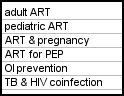
 ART
and pregnancyART and PEP
OI prevention
HIV and TB ART
and pregnancyART and PEP
OI prevention
HIV and TB
|
||||
|
|||||
|
RELATED INFORMATION: |
||||
|
|||||
|
guidelines newslinks newslinks |
||||
|
|||||
|
USPHS/IDSA Guidelines for the
Prevention of Opportunistic Infections
in Persons Infected with Human Immunodeficiency Virus, August 20, 1999
FAQ answers by Jonathan Kaplan, M.D. Q: Will the CDC/IDSA produce guidelines for managing opportunistic infections. If "yes," when is this likely to happen? A: Although the USPHS/IDSA Working Group felt strongly at its March 1999 meeting that guidelines for managing OIs would be helpful, no one has yet stepped forward to lead the effort. Hence, when this will happen is unclear. Q: When will the OI guidelines be updated again? Is there any thought to updating the information on the web in a fashion analogous to that used by the DHHS panel for antiretroviral agents? A: Yes, thought has been given to updating the guidelines in a manner analogous to that used by the DHHS Panel for use of antiretroviral agents. In fact, data presented at the 7th CROI suggest that there is now sufficient information to suggest the possibility of discontinuing primary prophylaxis against toxoplasmosis, and secondary prophylaxis against PCP, in persons whose CD4+ counts increase in response to HAART. Hopefully, a small group will be convened soon to address these issues. Q: There have been several reports of declining sensitivity of p.carinii to trimethoprim-sulfamethoxazole. Are there data suggesting reduced efficacy for PCP prophylaxis? Is anyone keeping track of this? A: Several investigators, in both the United States and Europe, are collecting BAL specimens from PCP patients to assess the relationship between mutations in the DHPS gene and exposure to sulfa prophylaxis. Such a relationship appears clear, but this does not necessarily mean that prophylaxis failure is clinically significant at this time. In fact, very few cases of PCP occur in persons who are prescribed and are adhering to TMP/SMX chemoprophylaxis. Work in this area is ongoing. Q: There was a paper at the 7th CROI in San Francisco indicating that one could safely stop secondary PCP prophylaxis. The guidelines obviously state that this prophylaxis should be continued. How does the clinician use this type of information, which seems scientifically credible, but is not compatible with the guidelines? A: When the USPHS/IDSA Working Group met in March 1999, it was not felt that data were sufficient to justify a recommendation to discontinue secondary PCP prophylaxis when the CD4+ count increases in response to HAART. However, two presentations at the 7th CROI suggest that there may now be sufficient data to allow such a recommendation, particularly when the CD4+ count has increased to above 200 cells/mm3 for at least 3-6 months. As indicated above, it is hoped that a small group of the USPHS/IDSA Working Group will address this issue soon. Q: With Hepatitis B vaccination, the guidelines do not mention measuring antibody to HBs in vaccinated patients with HIV infection. Should we be doing this? A: Measuring HBs antibody has not been discussed in the guidelines since it is not clear that doing this will be helpful. That is, patients who do not respond to vaccination, such as those with low CD4+ counts, may be unlikely to respond to additional doses of vaccine. However, this could change in the era of HAART. For example, a patient who was vaccinated at a low CD4+ count and has an undetectable response and whose CD4+ has increased in response to HAART might benefit from an assay for HBs antibody and subsequent revaccination. This is a good topic for the hepatitis experts to consider before the next revision of the guidelines. Q: I believe you authored a paper that suggested that the threshold for initiating PCP prophylaxis should be 250/mm3 rather than 200/mm3. Why is this not included in the current recommendations? A: The possibility of offering chemoprophylaxis to persons with a CD4+ count less than 250 cells/mm3 is mentioned in the guidelines as an option, particularly if several months are likely to elapse before another measurement is obtained. Q: Many of the patients with HIV infection in my region are injection drug users. A possible benefit of TMP-SMX prophylaxis is a reduction in infections caused by S. aureus, especially endocarditis. This is not mentioned in the guidelines. Is there evidence of this as a benefit in the subgroup of IDUs? A: Prophylaxis with TMP/SMX is likely to reduce the incidence of many bacterial infections, including those caused by S. aureus. In fact, an abstract suggesting protection against S. aureus, from CDC's Adult and Adolescent Spectrum of Disease Project, has been submitted to the World AIDS Conference which will be held in Durban this summer; the abstract does not specifically address IDUs. However, the USPHS/IDSA Working Group has been cautious in suggesting use of TMP/SMX specifically to prevent bacterial infections (that is, when not being used for PCP prophylaxis) because of the likelihood that the liabilities (widespread use in persons with lower risk of OI [CD4+ >200], toxicity that may preclude use of the drug in later stages of HIV disease, development of antimicrobial resistance) may outweigh the benefits. Whether this balance might be shifted with regard to S. aureus infection in IDUs has not been addressed. Q: Should INH always be given with pyridoxine in HIV-infected patients? Should liver function tests be monitored routinely? A: Although there are no controlled data indicating the benefit of pyridoxine, most experts feel that it should be used if the patient is at risk for neuropathy; this is in fact the case with most HIV-infected persons, who are at risk for HIV-associated neuropathy as well as neuropathy associated with various medications (besides INH). Hence, most experts feel that it is prudent to use pyridoxine with INH in this population. Similarly, liver function tests should be obtained in patients who are at risk for liver disease. This also is true for most HIV-infected persons, who may take other hepatotoxic medications and who also may be infected with hepatitis B or hepatitis C. Hence, liver function tests should be performed at baseline, but not necessarily later unless clinically indicated. |
|
|||
|
|||||
|
|||||